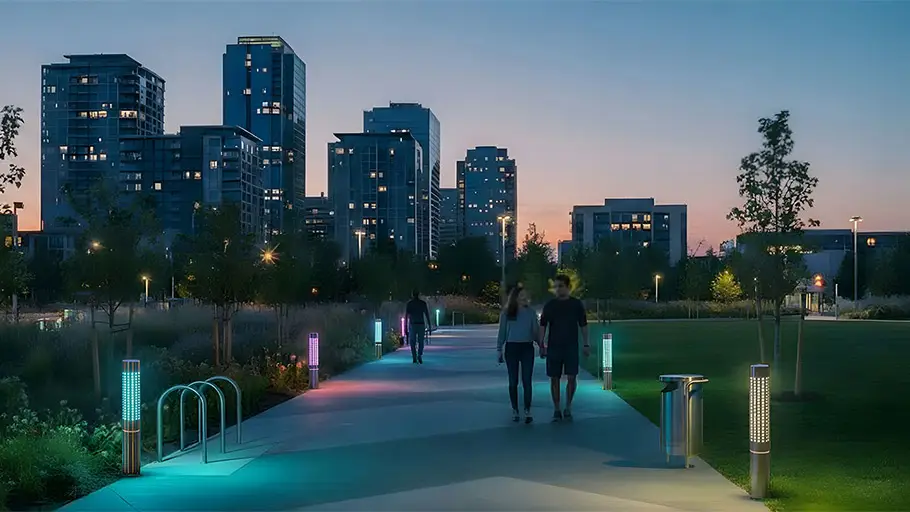



Smart Outdoor Lighting for Public Spaces: Introducing Lightshow Connected


The evolution of public lighting has entered a transformative era, where smart outdoor lighting systems are revolutionizing how cities, stadiums, and large facilities manage their lighting infrastructure. With approximately 326 million streetlights worldwide expected to grow to over 361 million by 2030, and 25% of these converting to smart networks, the lighting industry is experiencing unprecedented innovation.
Smart outdoor lighting represents more than just energy efficiency—it’s a comprehensive solution that integrates programmable controls, RGB capabilities, and intelligent management systems to create dynamic, responsive lighting environments that enhance safety, communication, and user experience.

What Is Smart Outdoor Lighting?
Smart outdoor lighting encompasses intelligent illumination systems that can utilize Internet of Things (IoT) technology, sensors, and centralized control platforms to deliver adaptive, automated lighting solutions. These systems go beyond traditional fixed-schedule lighting by incorporating real-time responsiveness, remote management capabilities, and programmable features that can adjust brightness, color, and operational patterns based on environmental conditions, user needs, and predetermined schedules.
Modern smart lighting systems integrate LED technology with wireless connectivity, enabling individual fixture control and network-wide management through centralized platforms. The technology combines energy-efficient LEDs with sophisticated control systems that can monitor performance, detect failures, and automatically adjust lighting parameters to optimize both energy consumption and illumination quality.

Benefits for Cities, Planners, and Large Facilities
Smart lighting can deliver substantial advantages across various operational areas. Energy efficiency represents the most immediate benefit, with systems typically reducing energy consumption by 50-70% compared to traditional lighting solutions. Cities implementing smart lighting report dramatic cost savings—Los Angeles has achieved over 60% energy savings and $10 million in annual cost reductions through smart lighting deployment.
The maintenance advantages are equally compelling. Smart systems provide real-time monitoring and predictive maintenance capabilities, enabling proactive identification of potential failures before they occur. This approach eliminates the need for traditional night patrols and reduces emergency maintenance costs by up to 70%. Remote monitoring capabilities allow operators to check any lighting situation from anywhere at any time, drastically reducing onsite trips and operational overhead.
Safety enhancement represents another critical benefit. Well-designed smart lighting systems can reduce crime rates by up to 20% and significantly improve visibility for pedestrians and vehicles. The ability to adjust lighting levels based on real-time conditions—such as increasing brightness during emergencies or high-traffic periods—creates more secure and navigable environments.
Environmental benefits extend beyond energy savings. Smart lighting systems contribute to reduced carbon footprints, with each kilowatt-hour saved preventing up to 900 grams of CO2 emissions in some regions. The systems also support dark sky compliance initiatives, reducing light pollution through precise control and directional lighting.

Lighting as Communication and User Experience
Smart outdoor lighting goes beyond traditional illumination by serving as a dynamic communication medium. Modern systems can convey information through color changes, brightness variations, and programmed sequences that guide users, indicate status, or enhance experiences. This communication capability transforms lighting infrastructure into an interactive interface between public spaces and their users.
The user experience enhancement is particularly evident in large venues and public spaces. Smart lighting can create immersive atmospheres that respond to events, celebrations, or seasonal themes. For example, lighting systems can automatically adjust to team colors during sporting events, create festive displays during holidays, or provide welcoming illumination that enhances the overall ambiance of public spaces.
Wayfinding applications demonstrate the communication potential of smart lighting. Color-coded lighting systems can guide pedestrians through complex spaces, indicate emergency routes, or highlight important areas. This visual communication approach transcends language barriers and provides intuitive guidance that enhances accessibility for all users.

RGB Bollard Lighting for Public Spaces
RGB bollard lighting represents a specialized application of smart outdoor lighting that combines the physical security and pathway illumination benefits of traditional bollards with the dynamic color capabilities of RGB LED technology. These systems enable the creation of programmable lighting displays that can adapt to various applications, from wayfinding and crowd management to atmospheric enhancement and event theming.
The technology integrates red, green, and blue LEDs within bollard fixtures, allowing for the creation of millions of color combinations through precise control of each color channel. When combined with white LEDs (RGBW systems), these fixtures can produce superior color accuracy and brightness levels while maintaining the ability to provide functional white lighting when needed.
Why stadiums and public areas benefit from programmable lighting
Stadiums and large public venues face unique lighting challenges that programmable RGB bollard systems are uniquely positioned to address. These facilities must accommodate diverse events, manage large crowds, and create memorable experiences while maintaining safety and operational efficiency.
The ability to program lighting for specific events represents a significant operational advantage. Stadium managers can instantly transform their lighting environment to match team colors, create game-day atmospheres, or support special events without requiring physical infrastructure changes. This flexibility allows venues to maximize their utility and create distinct experiences for different types of events.
Crowd management benefits are substantial in large venues. RGB bollard lighting can provide clear visual guidance for pedestrian flow, highlight specific areas or routes, and even indicate emergency procedures through color-coded systems. During peak times such as game entry or exit, these systems can direct traffic flow and reduce congestion through intuitive visual cues. Energy efficiency in stadium applications is particularly important given the scale of these facilities. Smart RGB bollard systems can provide optimal lighting while minimizing energy consumption through automated dimming, scheduling, and zone-based control. The ability to manage a large number of fixtures simultaneously from a centralized system enables efficient operation of large-scale installations.

Examples: wayfinding, crowd guidance, creating atmosphere
Wayfinding applications demonstrate the practical communication capabilities of RGB bollard lighting. Color-coded systems can guide visitors through complex venues by creating intuitive pathways—green lights might indicate standard routes, blue could designate accessible pathways, and red might highlight emergency routes. This visual guidance system reduces confusion and enhances the overall user experience.
Crowd guidance applications leverage the visibility and positioning of bollards to manage pedestrian flow during events. Some systems can be programmed to indicate optimal routes during different periods—blue lighting might guide incoming crowds to entrances, while amber lighting could direct exiting crowds to transportation areas. Dynamic programming allows these systems to adapt to real-time conditions, such as adjusting guidance patterns based on crowd density or weather conditions.
Atmospheric enhancement represents perhaps the most visible application of RGB bollard lighting. These systems can create immersive environments that support events, celebrations, or seasonal themes. During sporting events, bollards can pulse with team colors, create light shows synchronized with game highlights, or provide celebratory displays after victories. The ability to synchronize lighting across multiple fixtures enables the creation of complex, coordinated displays that enhance the overall venue experience.

Introducing Lightshow Connected
Bring your lighting strategy and crowd experience together with Lightshow Connected—Reliance Foundry’s smart control backbone for RGB-lit bollards. With one sleek panel and a web app to get connected, you can control and animate up to 255 fixtures in real time, matching team colors, guiding foot traffic, or staging full-scale light shows at the tap of a screen. Purpose-built for the demanding scale of stadiums and public venues, Lightshow Connected turns every bollard into a pixel in a venue-wide canvas—simplifying operations while unlocking unlimited creative potential.
How Lightshow Connected Works
Lightshow Connected represents Reliance Foundry’s comprehensive approach to smart bollard lighting control, designed specifically for stadiums, arenas, and large-scale public spaces. The system provides centralized control capabilities for RGB lighting installations, enabling operators to manage multiple fixtures through a single interface while maintaining the flexibility to customize individual bollard settings.
Centralized control with Lightshow panels
The core of the Lightshow Connected system consists of a centralized control panel that serves as the communication hub for all connected bollards. This panel manages data flow, processes control commands, and maintains system connectivity across the entire lighting network. The system’s architecture ensures reliable communication even in large installations, supporting robust operation in challenging outdoor environments.
The panel’s application interface provides intuitive control over the entire lighting system while the web interface provides status monitoring and easy connectivity of new bollards, enabling operators to verify system operation and identify any issues immediately.
ID assignment and Presets
Each compatible bollard in the Lightshow connected system receives a unique identifier that enables precise individual control. This ID assignment system allows operators to address specific fixtures or groups of fixtures (by odd or even ID) with pinpoint accuracy, supporting both individual customization and coordinated group displays.
The preset system enables operators to choose from a variety of combinations for different events, seasons, or operational needs. These presets can include complex color combinations, and effects that can be activated instantly when needed.
Manage up to 255 bollards simultaneously
The Lightshow connected system’s capacity to manage up to 255 individual bollards simultaneously represents a significant technological achievement that enables large-scale deployments. This capability ensures that even the largest venues can be managed through a single control system, providing consistency and efficiency in operation.
Each bollard maintains its programming independently, ensuring that temporary communication issues don’t disrupt the entire system operation. This approach enhances system reliability and reduces the impact of individual component failures.
Scalability features allow installations to grow over time without requiring system replacement. Additional bollards can be integrated into existing systems seamlessly, and the control capacity can be expanded to support larger deployments as needed. This scalability ensures that Lightshow Connected deployments can adapt to evolving facility requirements and expansion plans.

Use Cases for Smart Bollard Lighting
Smart bollard lighting systems find applications across a diverse range of environments, each leveraging the technology’s unique capabilities to address specific operational needs and enhancement opportunities. These applications demonstrate the versatility and practical benefits of programmable lighting systems in real-world settings.
Stadiums, event centers, university campuses, civic areas
Stadium applications represent one of the most dynamic use cases for smart bollard lighting. These venues require lighting systems that can adapt to various events, manage large crowds, and create memorable experiences. Smart bollards can display team colors during sporting events, create celebratory light shows after victories, and provide clear guidance for crowd movement during peak periods. The ability to synchronize lighting across multiple fixtures enables stadiums to create immersive environments that enhance the fan experience and support venue operations.
Event centers benefit from the flexibility of programmable lighting systems that can quickly adapt to different event types and requirements. Concert venues can create atmospheric lighting that complements performances, while convention centers can use color-coded systems to guide attendees to specific areas or events. The programming capabilities allow these venues to maximize their utility by supporting diverse events without requiring physical infrastructure changes.
University campuses present unique lighting challenges that smart bollard systems can address effectively. These environments require lighting that enhances safety, supports wayfinding, and creates welcoming atmospheres for students, faculty, and visitors. Smart bollards can provide color-coded guidance to different campus areas, enhance safety through responsive lighting that adjusts to activity levels, and create school spirit displays during special events or athletic competitions.
Civic areas, including parks, plazas, and public spaces, benefit from smart lighting systems that can enhance safety, support community events, and create engaging environments. These systems can provide seasonal displays that celebrate holidays or community events, enhance safety through adaptive lighting that responds to usage patterns, and create attractive environments that encourage public use of civic spaces.
Opportunities for seasonal themes, brand colors, and safety lighting
Seasonal theming capabilities enable public spaces to maintain dynamic, engaging environments throughout the year. Smart bollard systems can automatically transition between seasonal color schemes, create holiday displays, and support community celebrations through coordinated lighting programs. These capabilities help create sense of place and community connection while maintaining operational efficiency.
Brand color applications are particularly valuable for corporate campuses, entertainment venues, and institutional settings. Organizations can display their brand colors during special events, create welcoming environments that reinforce brand identity, and support marketing initiatives through coordinated lighting displays. The ability to program and modify these displays ensures that branding remains current and effective.
Safety lighting applications leverage the visibility and positioning of bollards to enhance security and emergency response capabilities. Systems can be programmed to provide enhanced illumination during high-risk periods, create clear emergency route guidance, and support security operations through responsive lighting that adapts to real-time conditions. Integration with security systems can enable automatic lighting responses to incidents or emergencies. The Future of Smart Lighting in Public Infrastructure
The evolution of smart lighting in public infrastructure represents a fundamental shift toward more intelligent, responsive, and integrated urban systems. As cities worldwide grapple with growing populations, environmental challenges, and the need for improved public services, smart lighting emerges as a critical foundation technology that enables broader smart city initiatives.

Integration with smart city ecosystems and IoT
Smart lighting systems are increasingly serving as the backbone for comprehensive IoT networks in urban environments. Street lighting infrastructure provides ideal positioning, power availability, and coverage for supporting additional smart city services beyond illumination. These systems can integrate environmental sensors for air quality monitoring, weather sensing, and noise level detection, creating comprehensive urban monitoring networks.
The integration capabilities extend to traffic management systems, where smart lighting can coordinate with intelligent transportation networks to optimize traffic flow and enhance safety. Lighting systems can respond to traffic conditions, provide visual guidance for autonomous vehicles, and support adaptive traffic management strategies.
Public safety integration represents another significant opportunity. Smart lighting systems can incorporate surveillance capabilities, emergency communication systems, and threat detection technologies. These integrated systems enable rapid response to incidents, provide real-time situational awareness to law enforcement, and enhance overall public safety through coordinated monitoring and response capabilities.
Data analytics capabilities enable smart lighting systems to provide valuable insights for urban planning and management. By analyzing usage patterns, energy consumption, and system performance, cities can make informed decisions about infrastructure investments, service delivery, and resource allocation.

Trends in programmable urban lighting
The programmable urban lighting market is experiencing rapid growth, with projections indicating the global smart street lighting market will reach $9.9 billion by 2025, growing at a compound annual growth rate of 24.8%. This growth is driven by increasing urbanization, environmental concerns, and the recognition of lighting as a foundational smart city technology.
Human-centric lighting approaches are emerging as a significant trend, with systems designed to support human circadian rhythms and well-being. These systems can adjust color temperature and intensity based on time of day, weather conditions, and usage patterns to create more comfortable and health-supportive environments.
Sustainability initiatives are driving the adoption of energy-efficient lighting technologies and smart control systems. Cities are implementing lighting systems that not only reduce energy consumption but also support renewable energy integration and carbon reduction goals.
The integration of artificial intelligence and machine learning capabilities is enabling more sophisticated lighting control and optimization. These systems can learn from usage patterns, predict maintenance needs, and automatically optimize performance to achieve energy savings and improved service delivery.
Connectivity improvements, including 5G networks and advanced wireless technologies, are enabling more responsive and capable smart lighting systems. These enhanced communication capabilities support real-time control, faster response times, and integration with other smart city systems.
Smart Outdoor Lighting FAQ
What is smart outdoor lighting?
Smart outdoor lighting is an IoT-enabled illumination system that uses sensors, connectivity, and centralized controls to adjust light levels automatically and be managed remotely.
How does Lightshow Connected work?
Lightshow Connected wirelessly controls up to 255 individually addressed bollards through a single panel that lets operators set presets, colors, and manage lighting.
Can Lightshow Connected be used with any bollard?
The system only works with Reliance Foundry bollards equipped with Lightshow Connected compatible hardware, though the roster of compatible models is continually expanding.
What are the benefits of RGB lighting in public spaces?
RGB lighting improves wayfinding, crowd flow, ambiance, safety alerts, and themed or branded displays in public areas.
Is Lightshow Connected scalable for large outdoor areas?
Yes—its distributed architecture lets a single controller reliably manage and grow installations of up to 255 bollards, making it suitable for stadiums, campuses, and other extensive sites.